Graphical Representation
April 11, 2014 § Leave a comment
Visual communication predates writing…

Caves of Chauvet, Paleolithic Era Circa 35,000 b.C.
But together with writing it implies a degree of abstraction that both helps communicate and also think the world around us. On the Mayan Codex of Dresden we can see for example, side by side, columns of phonetic scripture and numeric representations in base five, which helps understand and signify the number « O » common in Mesoamerican carvings in the first century b.C, 1300 years before Arab mathematicians introduced it to Europe, in the 12c.

Mayan writings circa 8c, reproduced in the Codex Dresden circa 11c a.D.
Graphic representations and texts complement each other and serve a double purpose of thinking and communicating. Pythagoras theorem by Leonardo or Euclides’ Elements circa 300 b.C. offer a good example of the later, while the graphical representation of Orbis Terrarum in Medieval manuscripts illustrates the later.

Leonardo’s illustration of Pythagoras theorem

Oliver Byrne’s edition of Euclides’ Elements, London 1847

Orbis Tertius & Mare Oceanum
The idea that graphic representation needs to accurately depict the relative magnitudes of what it is representing is necessary for deriving conclusions and using them as a thinking devices, but not for telling a story as is the case of the schematic representation of Orbis Tertius.
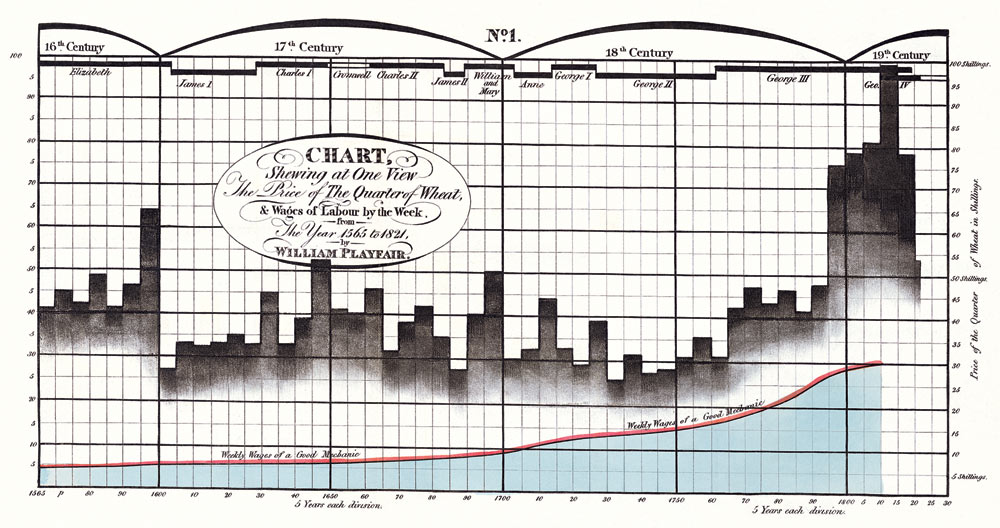
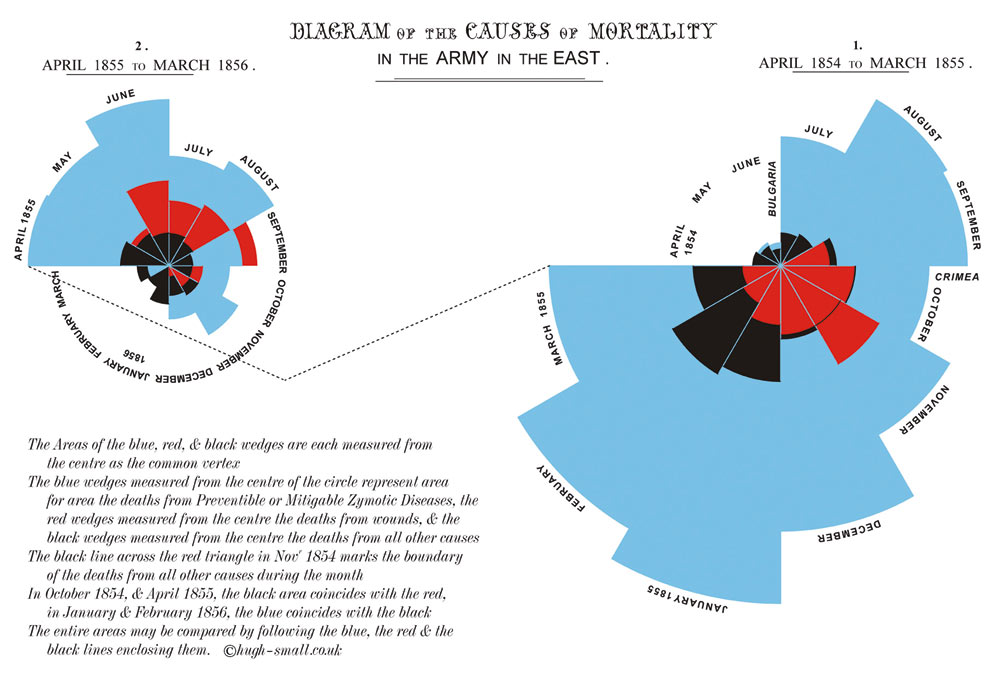
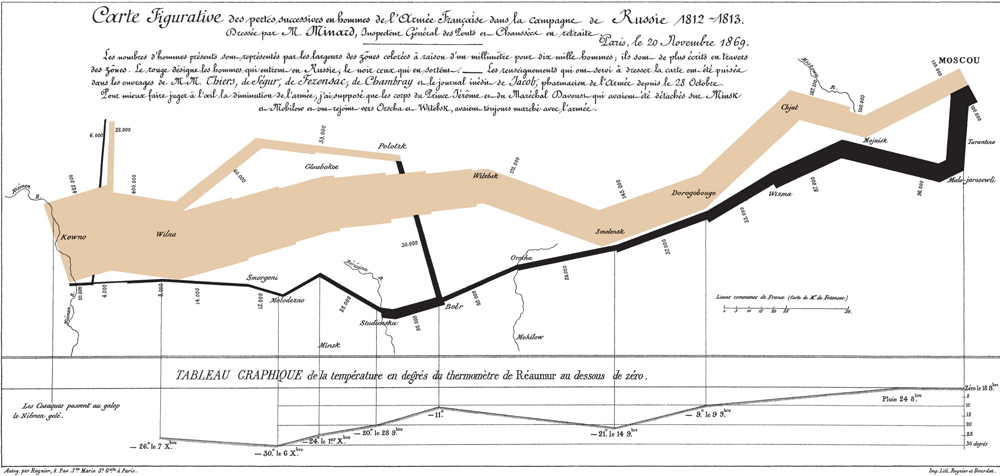
William Playfair’s 1821 engraved charts of historically declining purchasing power in the UK, Florence Nightingale’s rose graphs showing poor living conditions of military barracks in 1855, and especially Charles Minard’s graphic representation of Napoleon’s Russian campaign of 1812 started a turning point in visual representation of statistical data.
Edward Tufte’s The visual display of quantitative information (1983), Envisioning information (1990) and Beautiful evidence (2006) are considered the start of its associated scholarly inquiry. The chapter entitled « Chartjunk » in Beautiful evidence is often used as a basis for workshops on «Power Point communication best practices » for example the one that Ray Lyons addressed to medical research professionals in Baltimore, MD on 2010: “Best Practices in Graphical Data Presentation.” Stephen Few wrote an interesting review of the state of the “Chartjunk debate” in 2011 for business professionals.
Often quoted sources are Howard Wainer Visual Revelations (1997), Graphic Discovery (2005) and Picturing the Uncertain World (2009); Dona Wong the WSJ Guide to Information Graphics (2010) and Stephen Few Now You See It (2009), Show me the Numbers (2012) and Information Dashboard Design (2013). In terms of a textbook with a systematic step by step overview of the discipline, my favorite is Ricardo Mazza’s Introduction to Information Visualization (2009). The discipline has grown significantly in recent times with research focusing on data mining and visual thinking of big data.
Intercultural Communication: an introduction
November 18, 2013 § Leave a comment
Edward Hall’s book The Silent Language (1959) is often cited as the starting point of the field of Intercultural Communication in the United States. During WWII and at the beginning of the Cold War between 1946 and 1956, the U.S. Foreign Service Institute and the Department of State hired some of the best linguists and anthropologists to train members of the Foreign Service. Rather than traditional broad topics taught to college students, the task was to focus on small elements of culture, and on the role of non-verbal communication in social interaction. It has been argued that this prompted Hall’s book and the institutionalization of the discipline (Leeds-Hurwitz, 2014).
There are today a vast number of intercultural communication institutions, journals, book collections and conferences. A simple Google search shows the following amongst others: the International Communication Association, the International Academy for Intercultural Research, the International Association for Intercultural Communication Studies, or the Intercultural Communication Institute; the Journal of Intercultural Communication, the Journal of International Communication Research, the International Journal of Intercultural Relations, and Cultus: the Journal of intercultural mediation and communication.
The introductory course on Intercultural Communication for advanced undergraduates and graduates in U.S. Universities has also been subject to a relatively rich academic inquiry. A number of scholarly articles have dissected how it has been taught, with which goals, contents and methods. Some of these relfections are: Gudykunst, Ting-Toomey & Wiseman (1991), Milhouse (1997), Kalfadelis (2005) and some recent book reviews of textbooks, anthologies, readers and handbooks.
A multidimensional approach
Reviewing such a vast material can be daunting and requires at some point to commit to one or a few distinctive approaches. However, most articles coincide in that the most effective course design integrates multidimensional goals –cognitive, affective and behavioral—, combines culture-general and culture-specific content, and uses both intellectual and experiential learning processes.
Cognitive, affective and behavioral components
The cognitive component is developed through lectures, readings, class discussions, critical incidents, and small group interactions. It is tested through traditional research papers, for example comparing and contrasting intercultural and cross-cultural interactions between two or more cultures, individual and group presentations and structured exercises. The Affective component is developed through structured exercises, role-play, simulations and exercises involving interaction logs or identity-construction cards. The skill or experienced-based component is developed through simulations, observations, experience-based contacts and case studies.
Textbook selection
Classes are structured from a textbook or a reader, either off-the shelve or made ad hoc by the professor for the course. Most widely used textbooks in introductory courses are:
- Samovar, Porter & McDaniel. Communication between cultures. Wadsworth Publishing Company, 8th. ed. 2012.
- Samovar, Porter & McDaniel, eds. Intercultural communication: A reader. Cengage Learning. and Martin, 14th ed. 2014.
- Martin, J. and T. Nakayama. Intercultural communication in contexts. (2004).
- Martin, J. and T. Nakayama, eds. Experiencing intercultural communication. McGraw-Hill Higher Education, 5th ed. 2013.
Some of these textbooks were originally published in the 1980s and have been tweaked and updated ever since to reflect the change of times. Most of their theoretical approach has aged well, although they have been criticized for focusing on cognitive aspects with too little or nothing on affective and behavioral, and for having a too phalocentric WASP and Eurocentric perspective stressing culture-specific content and communication between national cultures as opposed to interpresonal and intercultural communication within national borders or in multicultural environments. Some of these criticisms have been addressed in the later editions, and it is important to note that these textbooks printed in the 1980s, have been successful in sufficiently keeping up with time, while others have not. The last one of the list, Experiencing intercultural communication is different first because it was first published in 1994, and also because it focuses on a more pragmatic and behavioral approach. The first one, Communication Between Cultures includes chapters on the importance of history and religion which no other textbook I have seen addresses.
I am leaving out some interesting textbooks of course, such as Ting-Toomey Communicating Across Cultures (1999) for example, only becasue they have not been updated or do not have all the supporting materials of the ones I have mentioned earlier.
The introductory course on Intercultural Communication is usually targeted at junior or senior college students. Advanced undergraduates and master students would benefit from the more structured textbook-based approach as it contributes to the clarity of the goals, methods and contents, but would require additional reading materials. A number of other readers and handbooks cover other aspects that may complement those textbooks. For example:
- Holliday, Hyde & Kullman Intercultural Communication: an advanced resource book for students 2nd. Ed. (2010) provides a more schematic approach emphasizing non-specific cultural approach, and both affective and behavioral exercises based on a simple model of identity-otherness-representation and the deconstruction of short fragments of text.
- Piller Intercultural Communication: A critical introduction (2011) Edinburgh UP on another hand focuses on multicultural individuals who may have a variety of cultural affiliations and proficiently interact in a diverse and multicultural environment. It is a comprehensive critical introduction to the field from a discourse analysis, social and anthropological linguistic perspective and illuminates differential prestige of languages and language varieties.
- Ting-Toomey and Oetzel, Managing intercultural conflict effectively (2001) is well grounded in the concepts and theories of both conflict management and intercultural communication, and is unique in the author’s use of system theory.
- Darla Deardorff’s Handbook of Intercultural Competence (2009) seeks to answer the question of «What is intercultural competence.» Her book is intended to be used in advanced Intercultural Communication courses.
Since no single book addresses the specific needs of an introductory intercultural communication class at a professional master’s level a good combination might be:
- Samovar, Porter & McDaniel. Communication between cultures. Wadsworth Publishing Company, 8th. ed. 2012. ($29-$123) ISBN-10: 111134910X | ISBN-13: 978-1111349103)
- Samovar, Porter & McDaniel, eds. Intercultural communication: A reader. Cengage Learning. and Martin, 14th ed. 2014. ($89 ISBN-10: 1285077393 | ISBN-13: 978-1285077390)
- Holliday, Hyde & Kullman Intercultural Communication: an advanced resource book for students 2nd. ed. (2010) ($47, ISBN-10: 0415489423 | ISBN-13: 978-0415489423)
- Plus complementary texts supplied by the instructor both from the other books mentioned, as well as key texts to cover intercultural mass-media communication, framing, intercultural conflict management and resolution and intercultural communication strategizing.
 alanjose